
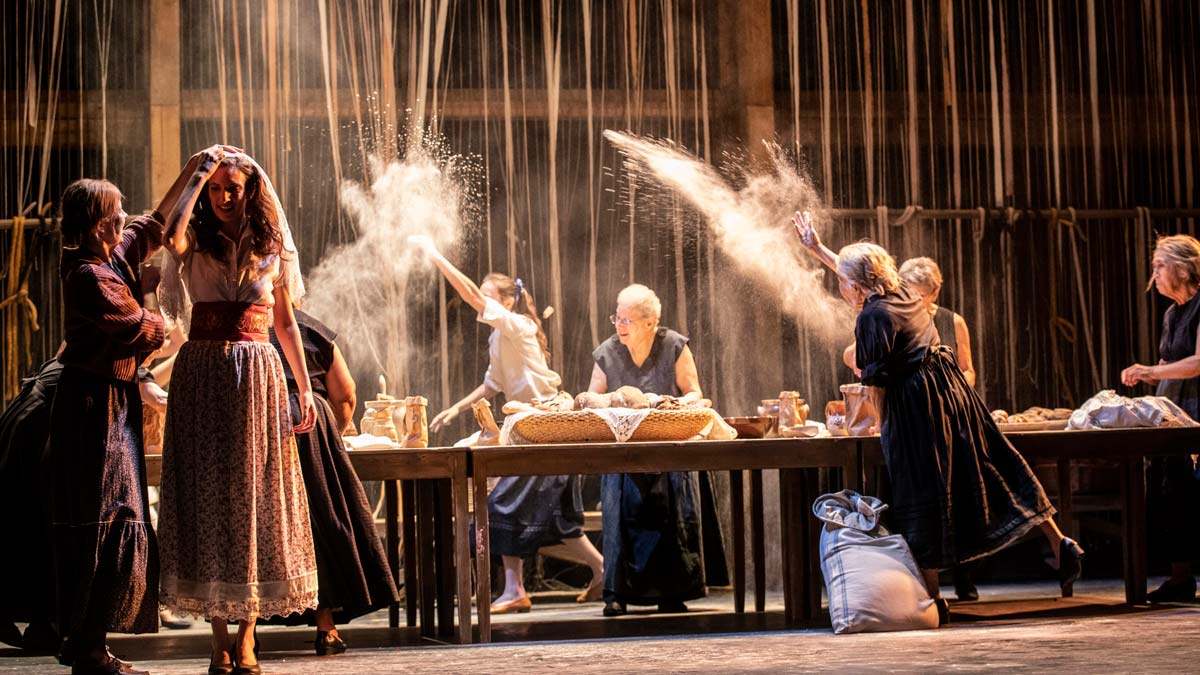
© Jean-Louis Fernandez
Accabadora, or the Soul of Sardinia, at the Aix-en-Provence Festival
José Pons - Olyrix - 06/07/2026
Premiered at the Théâtre du Jeu de Paume in Aix-en-Provence, *Accabadora*, a one-act chamber opera composed by Francesco Filidei, transports the audience to a Sardinian village in the 1950s, still steeped in vivid and powerful ancestral traditions.
Custom dictated that the upbringing of a young girl from a poor, large family should be entrusted to an elderly woman from the village, who was mysteriously respected by all. Here, Maria, ‘the child of the soul’, is raised with tenderness, certainly, but also with rigour by Tzia Bonaria Urrai, a childless widow and seamstress by trade.
The latter also fulfils a dreaded role: that of the Accabadora, the ‘last mother’, the one who puts the dying out of their misery to end their suffering. Maria gradually discovers this aspect of her adoptive mother’s unusual behaviour, as she is regularly called upon at night by the villagers to carry out this terrible duty.
Nicola, who, along with his younger brother Andria and Maria, is in charge of the grape harvest, suffers a serious leg injury and has his leg amputated. In despair, he begs Bonaria to end his life. At first, she vehemently refuses, before finally consenting on All Saints’ Night: she then smothers him with a pillow, whilst the horrified Andria looks on. Maria, now a young woman, flees from her mother – who has in the meantime confessed everything to her – and from her beloved Sardinia, seeking refuge in Turin. An exchange of letters with a friend from the village allows her to receive regular news. On learning that Bonaria is dying, she returns to her village in Sardinia. But Bonaria’s agony—as she refuses to let go—drags on for what seems like an eternity. Maria then recalls Bonaria’s words: ‘Never say you won’t drink from this water.’ She finally understands the profound meaning of the role of the Accabadora and seems to accept the fateful legacy. In a gesture suspended between love and fate, she, in turn, smothers her mother. Maria is now a woman in her own right and takes over the role of seamstress previously held by Bonaria.
Inspired by the spellbinding novel by the Sardinian author Michela Murgia, who passed away in 2023 at the age of 51, *Accabadora* incisively addresses a central issue that continues to be debated in modern societies: that of assisted or unassisted end-of-life care. Francesco Filidei wrote the libretto himself in close collaboration with Manuelle Mureddu, a specialist in the Sardinian language – or rather, the Sardinian languages. Consequently, the opera is sung in Italian and Sardinian, particularly in the choral sections, with French and English surtitles, of course.
The listener is undoubtedly unsettled by the premise and the very singularity of the subject matter. They thus find themselves at the centre of a constant and deeply personal line of questioning. This is all the more so given that, in contrast to the orchestral grandeur of his previous opera *The Name of the Rose* – premiered last year at La Scala in Milan (our review) and due to be staged in French by the Paris National Opera next season – the instrumental ensemble here is smaller (the musicians all belong to the Lyon Opera Orchestra) yet displays astonishing precision. Francesco Filidei has composed a score that is at once brilliant and highly refined, yet also haunting with its sounds that seem to come almost from the beyond, bringing to the fore the deeply endearing humanity of ordinary people. The vocal style characteristic of this composer, who has a particular love for Italian opera, is very much to the fore and can be appreciated in all its facets.
In her musical direction, Lucie Leguay captures all the turmoil and magic of the piece. The Israeli contralto Noa Frenkel, who regularly performs in the contemporary repertoire, embodies Tzia Bonaria Urrai with her imposing stage presence – an inexorable figure of fate, yet also a loving and attentive mother. Her voice possesses deep low notes and is imbued with a particularly sombre, pronounced timbre, which suits this central role perfectly.
Alongside her, the young French soprano Rachel Masclet embodies the role of Maria with complete authenticity, her voice radiant and unhindered.
The Italian baritone Lodovico Filippo Ravizza brings an energetic yet almost despairing presence to the role of Nicola. His voice is broad and powerful, well-prepared for the great roles in the repertoire which he has only been tackling for a few years. With a marvellous, luminous voice that is more than just a light tenor – he portrayed a haunting novice in *The Story of Billy Budd, Sailor* at last year’s Festival – Hugo Brady, with his tall, youthful figure, could well be Maria’s future lover, should fate so decree. Victoire Bunel is also superb in several successive roles – Maestra Luciana, Giannina Bastiu, Una voce – a sensitive artist with a fully developed vocal range. Francesco Leone, a strong and effective character bass, also takes on several roles.
These four artists, supported by the Polish soprano Olga Siemieńczuk, the American mezzo-soprano Camille Primeau, the Slovenian baritone Lovro Korošec and the French bass Constantin Goubet, form the chorus, which therefore sings in Sardinian.
Valentina Carrasco, in collaboration with Mariangela Mazzeo on set design, Mauro Tinti on costumes and Antonio Castro on lighting, has taken on the production with an enthusiasm that is evident throughout the performance. It is the very life of this village that she brings to life before our eyes, with these elderly women, all dressed in black, baking their daily bread or making basic pasta, busy treading grapes or keeping an ear out for all the gossip circulating amidst these Christian symbols that suffocate the space and stifle the future.
Clear and executed with pinpoint precision, the staging – in which weaving, incidentally, plays a central role in daily life – and Valentina Carrasco’s approach avoid any superfluous or uncertain folklorism, placing the human element at the forefront. Co-produced by several French and international theatres (Luxembourg, Erl, Lyon, Dijon and Bologna), *Accabadora* reveals a fascinating new facet of the composer Francesco Filidei. The production has been enthusiastically received by audiences at the Festival d’Aix and is bound to ensure the work’s enduring legacy.