
Solaris, une odyssée sonore entre mémoire musicale et vertige cosmique
Victoria Okada - Première loge opéra - 09/05/2026
Solaris, Nantes, Théâtre Graslin, Wednesday 6 May 2026
Othman Louati and Jacques Perconte have created a hybrid work in which voice, image and electronics interact in a fascinating sensory continuum
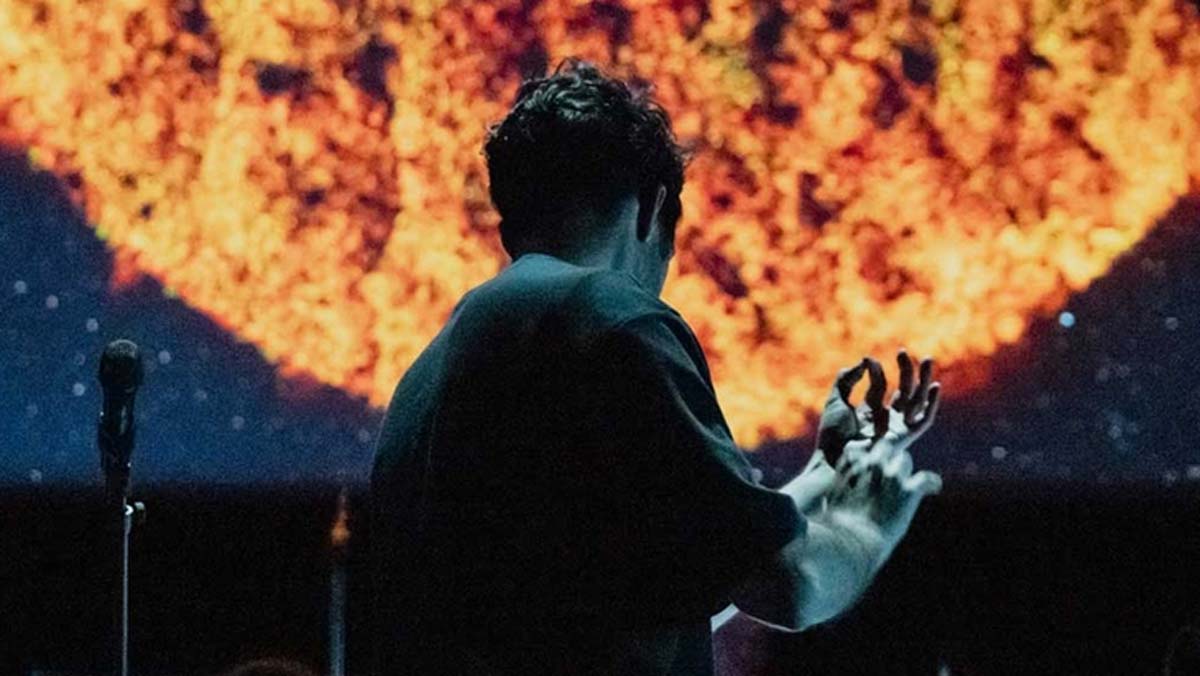
The production of *Solaris*, by composer Othman Louati and video artist Jacques Perconte, continues at Angers-Nantes Opéra following its premiere last April in Roubaix by the Atelier Lyrique de Tourcoing; the work will then be performed in Grenoble at the end of the month. Described in the programme as a ‘video-opera’, inspired by Stanislaw Lem’s novel and Andrei Tarkovsky’s film, it is in reality more akin to a contemporary secular cantata, blending singing, readings of texts by Jacques Perconte — sometimes whispered, sometimes delivered in ASMR — and instrumental music.
Music rooted in Western traditions
At the end of the performance, the lights go out, leaving the story shrouded in a kind of mystery, after an hour of music and video. An hour without a single lull, during which the listener’s attention never wavers. Deeply rooted in the tradition of Western music, Othman Louati’s score is by no means pedantic and remains accessible to all listeners. Within this heritage, French music—particularly that from the late 19th century to the present day—seems to run through the work like an undercurrent, without ever allowing itself to be clearly identified.
The very structure of the piece draws on familiar forms: a prologue first sets the dramatic context, followed by a succession of scenes that regularly bring about changes in the situation. Whether consciously or not, one’s mind turns to lyric tragedy or grand opera. Whilst the prologue is sung in its entirety, the main body of the work alternates between vocal passages and recitations of text, sometimes delivered in a classical style, sometimes in ASMR mode — that neurocognitive phenomenon popularised by social media — achieved here through whispers delivered as close as possible to the microphone. For opera enthusiasts, this alternation between singing and speaking evokes opera-comique, Singspiel and even Sprechgesang, all within a resolutely modern framework. The whole, however, remains entirely at the service of the narrative, both textual and musical.
However, amidst these references and traditions, it is undoubtedly the use of electronic sound that attracts the most attention. Rather than using it continuously, as is often the case in so-called contemporary music, Louati regards it as a sonic material, a timbre amongst the other instruments, which he introduces only when he deems it necessary and dramaturgically effective. Sometimes reduced to a single electronic sound, sometimes deployed through a spatial arrangement of the loudspeakers, it always intervenes at key moments in the narrative. The same principle applies to the electric guitar and the synthesiser. This introduces a new perspective into the score, lending it a fresh quality. Thanks to this approach, the soundscape is almost never saturated with amplified sounds and never tires the ear. The balance between the strings (violin, viola, cello), the woodwinds (horn, flute, clarinet), the percussion, the synthesiser and the amplification equipment proves to be subtle and particularly well thought out.
Jacques Perconte’s images: between representation and sensation
The work of Jacques Perconte, one of the most renowned video artists in this field, remains largely figurative and directly complements the narrative: seascapes or cityscapes, the sky, the horizon, birds, an oil rig, the expansion of the universe, planets or the sun. The images strike the viewer with their poetic beauty. Nothing seems to artificially seek to create a sense of novelty; yet they exude a dimension that goes beyond mere illustration. What is most surprising is the sense of complicity that seems to unite these images with the music. After the performance, Perconte confides that this relationship is partly created by the viewer’s gaze. This fourth collaboration with Louati, fuelled by lengthy discussions with the composer, nevertheless enables him to conceive images that are deeply attuned to the music, even before he knows it in detail. He himself admits to being surprised by the highly interactive nature of the result, an observation shared by Louati.
Victoire Bunel, a vocal chameleon of great nobility
The sole voice in the work is that of Victoire Bunel. Throughout this cosmic journey, the mezzo-soprano ventures on several occasions well beyond her usual vocal range, particularly in the lower register, where her lyrical voice can no longer truly unfold. Yet this constraint becomes an expressive resource here. Bunel uses it to create an atmosphere and a timbre that are at once unfamiliar, unsettling, mystical and at times rough.
The sole voice in the work is that of Victoire Bunel. Throughout this cosmic journey, the mezzo-soprano ventures on several occasions well beyond her usual vocal range, particularly in the lower register, where the operatic voice can no longer truly unfold. But here, this constraint becomes an expressive resource. Bunel uses it to create an atmosphere and a timbre that are at once unfamiliar, unsettling, mystical and at times rough.
The score demands constant shifts in register — spoken, sung, whispered — as well as in vocal colour, sometimes within the space of just a few seconds. She rises to this challenge with remarkable ease, like a chameleon continually adapting to the soundscapes she traverses.
If there were to be one reservation, it would concern certain passages where the ensemble drowns out the voice when Bunel sings in the very low register, and this happens on several occasions. A few adjustments to the balance could, however, easily resolve this problem.
Having attended *Solaris* – which might ultimately be described more as a contemporary oratorio than a video-opera – one thing is clear: the work seems to have been conceived by and for music lovers capable of embracing, without hierarchy or rejection, the many strands of the Western musical tradition.