
Skip to main content Scroll Top

Weinberg’s La Passagère at the Capitole in Toulouse

“Victoire Bunel delivers a powerfully moving vocal performance for Krystina, oscillating between consolation and torment.”

© Mirco Magliocca

Weinberg's La Passagère at the Capitole in Toulouse

Jules Cavalié - 25/01/2026

Words fail us: they stumble, distort and dull the reality of this deeply moving performance. One must imagine the encounter between horror and beauty, and experience an incurable pain that only the testimony of incredible dignity makes tolerable. Mieczysław Weinberg’s work is adapted from the radio play ‘The Passenger in Cabin No. 45’ by Auschwitz survivor Zofia Posmysz, written after she heard a woman’s voice that reminded her of a concentration camp guard. On a transatlantic liner, a young couple celebrates the success of the husband, who has just been appointed West German diplomat to Brazil. The lovers enjoy the luxury of the ship and the future happiness of a ‘second honeymoon’. But one glance makes the moon pale and the honey bitter: Lisa, the wife, thinks she recognises Marta, a prisoner at Auschwitz where she was one of the guards. Between bouts of guilt, a deep desire to exonerate herself, and the conviction that she too was a victim, Lisa – the former SS officer Anneliese Franz – tells her husband about the camp and her encounter with Marta. Thus, in a back-and-forth between the camp and the ship, memories return in flashbacks, increasingly poignant and terrifying. This story of memory, guilt and denial is set to an equally complex musical score. The scenes on the ship are accompanied by music that oscillates between jazz and light music. For Auschwitz, Jewish, Polish, Russian and Czech chants resound, put into perspective by harmonies that are alternately distant or at the heart of the turmoil.

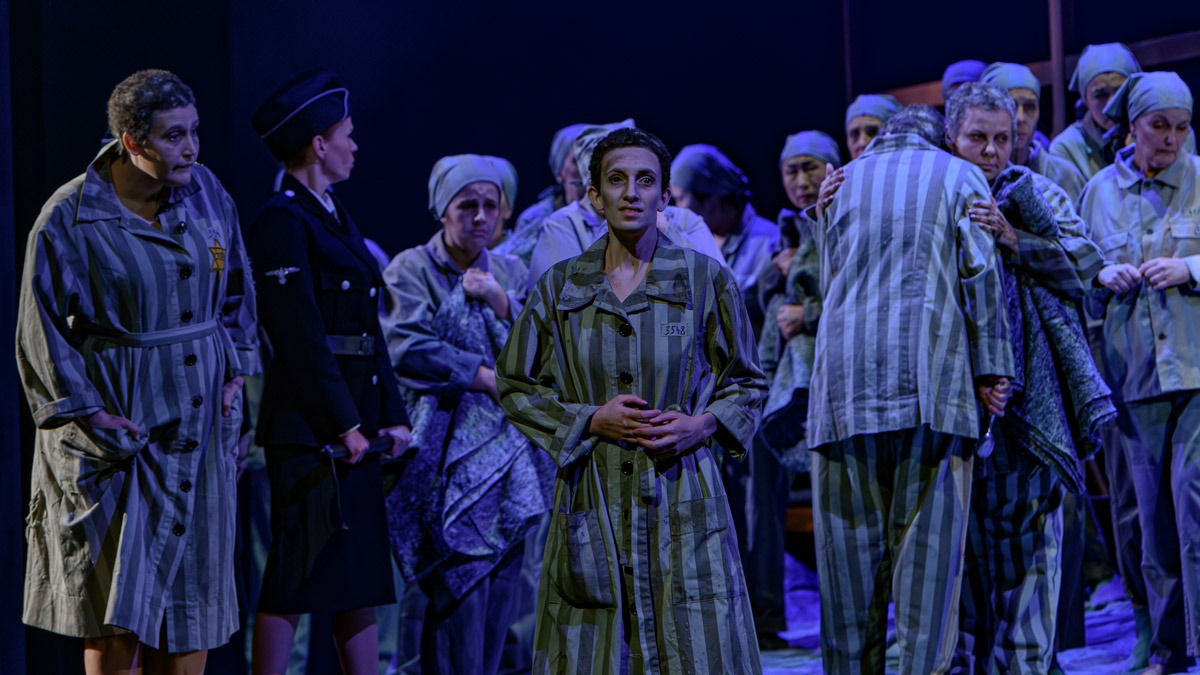
The undeniable success of this evening is due to the quality of the collective work of an exemplary team. The very brief and apt interventions of the solid bass Hazar Mürşitpinar (an old passenger), the retorts delivered like fatal blows by Manuela Schütte (kapo and head guard), the chilling performances of the three SS officers, the imperious baritone of Damien Gastl, the smoky bass of Baptiste Bouvier and the powerful tenor of Zachary McCulloch, as well as the lines delivered by actor Frédéric Cyprien (the steward), all contribute to the tension of a show that plunges us into a bottomless abyss. The group of prisoners is not simply a gallery of portraits of women in pain. Animated by genuine solidarity, torn apart by the divisions that the Nazis try to impose on them, each has her own personality, her own unique way of experiencing the abomination: one is a devout believer, another is Russian, a French woman retains a glimmer of hope, and yet another is on the verge of madness. Then there is life, which goes on despite its imminent destruction, the essential joys that remain – such as Marta’s birthday – between the bullying and the grim calls to the extermination chambers. All the performers embody these characters, torn between wandering and light, with astonishing accuracy: Ingrid Perruche, a soprano on the verge of madness as the Old Woman; Janina Baechle, who is mind-blowing both for the range of her voice and the intensity she brings to the deeply pious Bronka; Julie Goussot (Yvette) with her luminous soprano voice that brings a glimmer of light into the darkness, Sarah Laulan (Hannah) with her generous contralto voice for the heart-rending lament of a woman who knows she is doomed because she is Jewish, and Anne-Lise Polchlopek as the anxious and devoted Vlasta. Victoire Bunel delivers a powerfully moving vocal line for Krystina, torn between consolation and torment, and Céline Laborie sings nostalgically of Katja’s native Russia with a supple voice. Finally, baritone Mikhail Timoshenko delivers the superb role of Tadeusz with a velvety voice and finely crafted singing, while Airam Hernandez puts his sonorous voice at the service of Walter, Lisa’s weak-willed and opportunistic fiancé, precise in his delivery and the character’s versatility.
Nadja Stefanoff returns to the role of Marta, the Passenger, which she embodies completely. With her beautiful, resonant voice, she delivers a marble-like performance, in which her dignity as a resistance fighter is tinged with love and compassion. From this perspective, the scene of her reunion with Tadeusz is one of the most moving of its kind. Spectral in the epilogue, she engraves the names of her deceased camp comrades in our ears, because “if the echo of [their] voices fades, we will all perish…” Marta’s resolute and illuminating flame is contrasted with Lisa’s incendiary fire. Anaïk Morel gives herself entirely to this terrifying pyre. She seizes on the banality of evil to give it substance: panicked, gnawed by doubt, abominably self-assured, the former camp guard is an odious character imbued with such human feelings. The mezzo-soprano, whose rich voice is constantly called upon across its entire range, varies her delivery to perfection to convey the variety of this character’s emotions and elicit repulsive pity. Director Johannes Reitmeier opts for literalism: on stage, the wooden structure is both an ocean liner and a camp barracks, immediately establishing a sense of unease and the immovable presence of trauma. The direction of the actors thus presents the relationships between the prisoners with precision, characterizing each character with finesse and sparing the audience nothing of the brutality and dehumanization to which the deportees are reduced. Francesco Angelico conducts the magnificent Orchestre National du Capitole with uncompromising skill. He draws out a rich sound, playing with a gritty, muted orchestration that occasionally gives way to surges of energy. The conductor leads the music with a sense of narrative that avoids sentimentality without detracting from the lyricism. The chorus, prepared with precision by Gabriel Bourgoin, gives voice to the relentless voices of the deportees with powerful breath. The Toulouse audience greeted the French premiere of Mieczysław Weinberg’s La Passagère with thunderous applause, making us hope that this masterpiece will often find its way to the stage, and inviting us in the meantime to preserve the memory of this necessary moment.